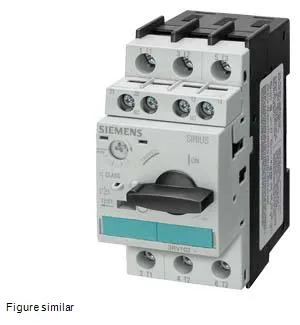
It provides overload and short-circuit protection for motors up to 0.18 kW at 400 V AC, with a continuous current rating of 0.8 A and Trip Class 10 — meaning it will trip within 10 seconds at 7.2× the set current, fast enough to protect standard induction motors from locked-rotor heating. The 100 kA breaking capacity at 400 V AC (and across the full range up to 690 V AC) means this device can safely interrupt fault currents up to that level without upstream fuses needing to clear — a key spec for panel SCCR compliance under UL 508A or IEC 60947-2.
The 0.8 A continuous current sets the motor FLA it protects — match this to your motor nameplate. The Trip Class 10 characteristic is the standard for most general-purpose motor starters (conveyors, pumps, fans); it allows brief starting inrush without nuisance tripping while still protecting against sustained overload. Ground fault detection is not included, so that function would need a separate GFPE device if required by code. The 100 kA breaking capacity at 400 V AC is the same at 240 V, 500 V, and 690 V AC — a flat high-fault curve that simplifies coordination studies. At 7.25 W power dissipation in hot operating state, plan for heat rise inside the enclosure; multiple units ganged may need derating or forced ventilation. Operating frequency is limited to 15 switching operations per hour at AC-3 duty — fine for occasional start/stop cycles on a conveyor zone or pump, but not for high-cycling applications like a stamping press or rapid reversing.
Width 45 mm, height 97 mm, depth 96 mm. Main terminals accept 2x (0.5... 1.5 mm²) solid or 2x (1... 2.5 mm²) stranded, plus AWG 14-10. Auxiliary/control terminals accept 2x (0.5... 1.5 mm²) solid or 2x (0.75... 2.5 mm²) stranded. The transverse auxiliary switch design means the auxiliary contacts are arranged side-by-side, not stacked — verify wiring access in dense panels. Shock rated 25g for 11 ms. Mounting position any.
RoHS compliance date is 01.05.2012.