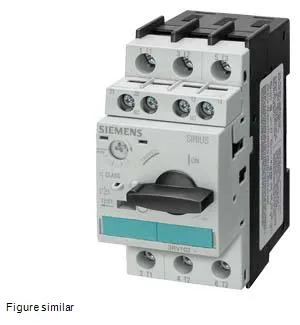
The Siemens 3RV1021-1CA15 is a SIRIUS motor-protection circuit breaker rated for 2.5 A continuous current with a Class 10 trip characteristic, meaning it will trip within 10 seconds at 7.2× the thermal setting — appropriate for standard induction motor starting profiles on pumps, fans, and conveyors.
Width is 45 mm, depth 96 mm, height 97 mm — fits a standard 45 mm-wide module slot on the rail; the 0 mm clearance at the side and backwards means it can be mounted flush against adjacent devices without derating. Front IP20 protection covers the operator interface; the screw-type terminals for main and auxiliary circuits accept solid conductors from 0.5 to 2.5 mm² and stranded from 1 to 6 mm².
Ratings and Selection Notes
Auxiliary switch is transverse design and the product extension for an auxiliary switch is available, so you can add a signal contact for remote status indication without a separate interface relay. Maximum operating frequency at AC-3 duty is 15 operations per hour — this is a thermal limit, not a switching-speed limit; for high-cycle applications like rapid reversing, a contactor with a higher rated frequency would be needed. Power dissipation in hot operating state is 7.25 W; factor this into the panel thermal budget when calculating enclosure ventilation.