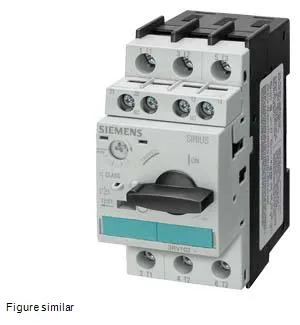
It is part of the SIRIUS product family, a widely used industrial control component line. Rated at 4 A continuous current with Trip Class 10, it provides fast overload protection for motors up to 1.5 kW at 400 V AC (AC-3 duty). Built-in phase failure detection protects three-phase motors against single-phasing, a common cause of winding burnout. No ground-fault detection on this variant.
Occupies 45 mm width, 97 mm height, 96 mm depth — a standard three-module footprint that fits most panel layouts. Any mounting position allowed. Front face carries IP20 protection — touch-safe for standard panel environments, but not washdown-rated. Screw-type terminals on both main and auxiliary circuits; accepts solid conductors 2x (0.5…1.5 mm²) and 2x (0.75…2.5 mm²), stranded 2x (1…2.5 mm²) and 2x (2.5…6 mm²). AWG equivalent 2x (14…10) for main contacts. Auxiliary switch contact rated 1 A at 24 V, 0.5 A at 230 V, 0.15 A at 60 V — suitable for signaling to a PLC input or status lamp. Transverse design auxiliary switch ships with the base unit; product extension for auxiliary switch is yes, meaning add-on blocks can be fitted.
Shock rated 25 g / 11 ms. Substance prohibition date 01.05.2012 indicates RoHS compliance (RoHS directive 2011/65/EU effective from that date). Power dissipation 7.25 W in hot operating state at rated current — factor into panel thermal calculations when grouping multiple breakers.