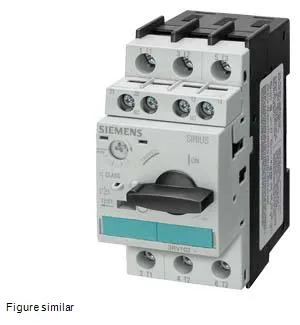
It's a current-production part with a continuous current rating of 4 A and a CLASS 10 trip characteristic, meaning it will trip within 10 seconds at 7.2x the current setting — fast enough to protect standard motors during a stall or locked-rotor condition without nuisance tripping on normal starts.
Breaking capacity — where it clears
This breaker delivers 100 kA breaking capacity at 240 V, 400 V, and 500 V AC, dropping to 6 kA at 690 V AC.
Depth is 96 mm, height 97 mm. That 96 mm depth is the body plus the screw terminals; ensure the enclosure has at least 110 mm clearance from the rail to the door or back wall for wiring access.
Main circuit terminals are screw-type. They accept solid conductors: 2x (0.5 to 1.5 mm²) and 2x (0.75 to 2.5 mm²). Stranded: 2x (1 to 2.5 mm²) and 2x (2.5 to 6 mm²). That's enough for a 4 A motor circuit — typically 1.5 mm² or 2.5 mm² stranded is fine. The auxiliary switch terminals are transverse design and rated 1 A at 24 V, 0.5 A at 230 V, 0.15 A at 60 V — enough for a PLC input or a contactor coil, but check the inrush if driving a relay.
Environment and endurance
Shock rated at 25 g for 11 ms — survives typical panel vibration and transport drops. Mechanical endurance of the main contacts is 100,000 operations. Maximum switching frequency in AC-3 duty is 15 operations per hour — fine for a pump or fan start, not for a rapid-cycling application.