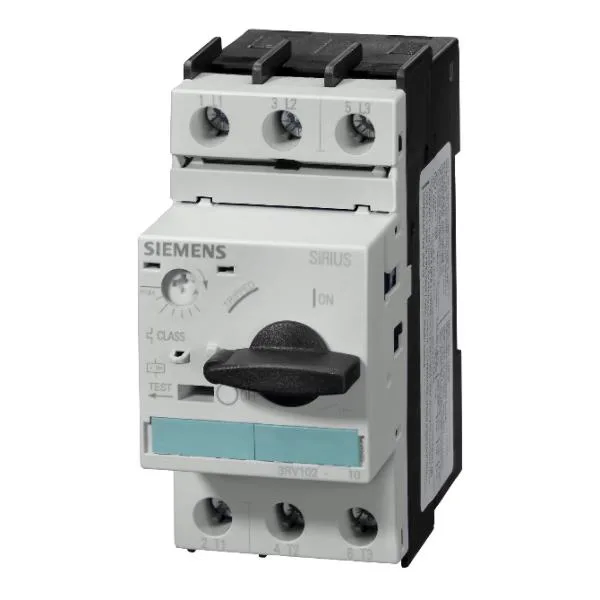
It's rated for a continuous current of 6.3 A and switches motor loads up to 2.2 kW at 400 V AC (AC-3 duty).
Breaking capacity — what it handles in a fault
This breaker carries a breaking capacity of 100 kA at 240 V, 400 V, and 500 V AC, dropping to 6 kA at 690 V AC. At 690 V, the 6 kA rating still covers most motor branch circuits in industrial environments.
The 45 mm width (3 module spaces) fits standard enclosure rail. Screw-type terminals on the main circuit accept solid or stranded conductors: 2× (1 … 2.5 mm²) or 2× (2.5 … 6 mm²), with AWG equivalents of 2× (14 … 10). No special tools beyond a screwdriver needed for termination. Zero clearance required at the sides or rear — 0 mm backwards and at the side — so you can pack modules tight on the rail.
IP20 protection on the front (finger-safe terminals), suitable for installation inside a locked or tool-accessible enclosure. Shock resistance of 25g for 11 ms — survives typical industrial vibration and occasional impacts. Mountable in any position, which simplifies panel layout.
Protection and diagnostics features
Includes phase failure detection — if one phase drops out, the breaker trips to prevent single-phasing motor damage. No ground fault detection built in (you'd need a separate GFPE module for that). An auxiliary switch is available (order separately) for remote status indication. The breaker has a typical mechanical life of 100,000 operations on the main contacts, and at AC-3 duty it's rated for 15 switching operations per hour maximum — adequate for most motor start applications, but not for frequent jogging or reversing cycles.