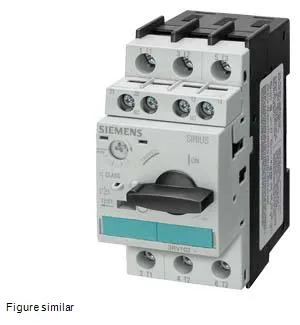
Motor protection circuit breaker, 8 A, Class 10 — SIRIUS 3RV1021-1HA38-1KT1
It switches a 3 kW motor load at 400 V AC (AC-3 duty) and delivers a 100 kA breaking capacity at 400 V AC, dropping to 42 kA at 500 V AC and 6 kA at 690 V AC. The main current circuit uses screw-type terminals (accepting 2x 0.25–2.5 mm² solid or 2x 24–14 AWG), while the auxiliary and control circuit uses spring-loaded terminals — a mixed termination scheme that saves panel wiring time on the control side while keeping power connections under a screw clamp. The 45 mm wide, 97 mm high, 96 mm deep footprint mounts via screw and snap-on onto a 35 mm DIN rail per EN 50022, in any mounting position. Power dissipation in hot operating state is 9.25 W, which should be factored into enclosure thermal calculations when grouping multiple breakers.
At 240 V AC and 400 V AC the breaker achieves 100 kA breaking capacity — sufficient for most industrial panel fault levels. At 500 V AC it drops to 42 kA, and at 690 V AC to 6 kA. Operating frequency at AC-3 is 15 operations per hour maximum, which governs the duty cycle for motor starting applications.
Shock resistance is 25 g for 11 ms. The auxiliary switch is transverse design and the product extension auxiliary switch is available as an option. Backwards and side clearances are 0 mm, meaning the breaker can be mounted flush against adjacent devices without derating — useful for dense panel layouts.