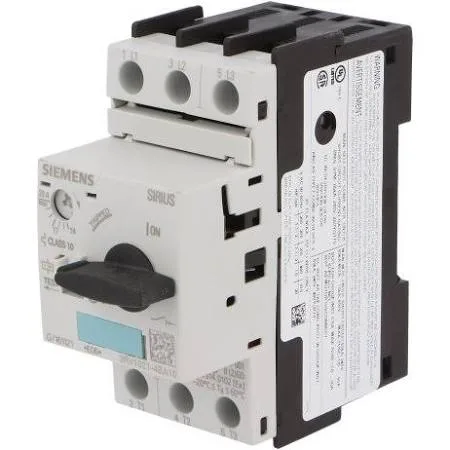
Rated 7.5 kW at 400 V AC, with a breaking capacity of 50 kA at 400 V AC and 100 kA at 240 V AC. For a motor protection breaker, phase loss is the common killer — a single-phased motor draws locked-rotor current on the remaining phases, and Class 10 clears it fast enough to keep the winding from cooking.
Zero clearance needed at the sides or back — 0 mm backwards clearance means you can butt it against the backplane without derating. Main and auxiliary/control circuits both terminate on screw-type terminals. Accepts solid or stranded conductors: 2x (1... 2.5 mm²) and 2x (2.5... 6 mm²) per clamp, or AWG 14–10 for the main contacts. Fine-stranded wire needs a ferrule (core end processing). The dual-wire capacity is useful when you're looping through to a downstream contactor without a separate terminal block. That 45 mm width is three 15 mm module slots on a standard DIN rail — plan your enclosure fill factor accordingly.
Environmental and electrical ratings
Shock rated at 25g for 11 ms, which covers most industrial vibration from nearby conveyors or compressors. Rated insulation voltage 690 V, surge voltage resistance 6 kV. Maximum operating frequency in AC-3 duty is 15 operations per hour. Not a rapid-cycling part; if your application needs frequent starts (like a crane or press), you'll want a contactor with a higher rated operational current or a dedicated motor starter. Power dissipation is 9.25 W total in hot operating state, or 3.1 W per pole.
RoHS compliance date is 01.05.2012, so it meets the EU RoHS directive for substances.