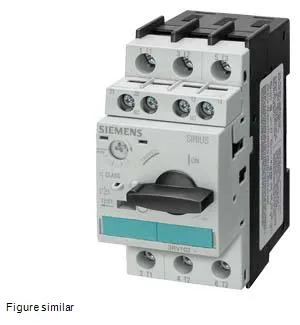
It carries a continuous rated current of 20 A and a trip class of CLASS 10, meaning it will trip within 10 seconds at 7.2× the set current — fast enough to protect standard induction motors during locked-rotor conditions. Breaking capacity is rated at 100 kA at 240 V AC, 50 kA at 400 V AC, 10 kA at 500 V AC, and 4 kA at 690 V AC — these figures tell you the maximum fault current the breaker can safely interrupt at each voltage level, critical for verifying SCCR compliance in the panel. Ground fault detection is not included, so if that's required, you'd need a separate ground-fault relay or a different breaker variant.
Depth is 96 mm, so check gland plate clearance if the panel is shallow.
Main and auxiliary/control circuits use screw-type terminals. The main contacts accept solid conductors: 2× (0.5–1.5 mm²) or 2× (0.75–2.5 mm²), and stranded: 2× (1–2.5 mm²) or 2× (2.5–6 mm²). AWG equivalents for the main contacts are 2× (14–10). The auxiliary switch is a transverse design and is field-installable.