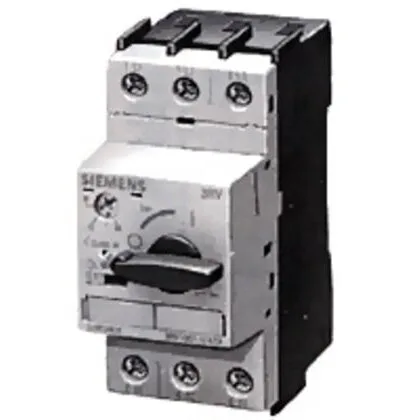
It is a current-production part, actively manufactured.
The 45 mm width (three 15 mm modules) fits standard panel spacing. Any mounting position is allowed, so it can be oriented to match the wireway layout. Depth is 96 mm, height 97 mm. Backwards clearance is 0 mm — it can sit flush against a back panel or another device. Side clearance is also 0 mm, so adjacent breakers can be ganged without extra spacing. Screw-type terminals on both main and auxiliary/control circuits accept solid or stranded conductors: 2x (1…2.5 mm²) and 2x (2.5…6 mm²). AWG equivalents are 2x (14…10).
Breaking capacity drops with voltage: 100 kA at 240 V AC, 50 kA at 400 V AC, 10 kA at 500 V AC, and 4 kA at 690 V AC. Maximum operating frequency is 15 switching cycles per hour at AC-3 duty — suitable for motor start/stop applications but not for high-cycle jogging or inching. Power dissipation is 10.5 W total (3.5 W per pole) in the hot operating state, which should be factored into enclosure thermal calculations. Shock resistance is rated at 25 g for 11 ms, so it will hold calibration and not trip falsely under vibration from contactors or heavy machinery on the same panel.
The substance prohibitance date of 01.05.2012 indicates RoHS compliance from that date onward. The auxiliary switch product extension is available (sold separately), allowing remote status indication or interlocking. Ground fault detection is not built in — that requires an external module or a different breaker variant.