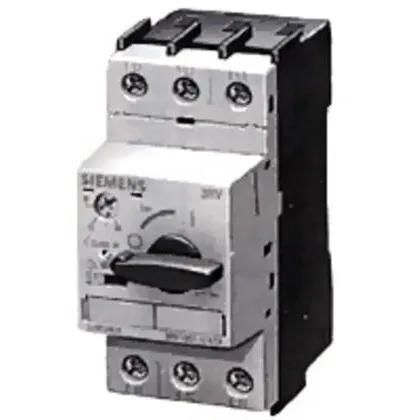
It's designed for motor protection, meaning it tracks current and temperature to catch an overload before the winding insulation gives up, and it clears a fault fast enough that the contactor downstream doesn't weld shut. That's enough for most industrial distribution panels fed by a transformer in the 500–1000 kVA range — you're not going to outrun this breaker on a typical motor branch circuit.
The 25 A continuous rating is the thermal setting range — you set the overload dial to match the motor's full-load amps, and the bimetal element tracks the heating curve. At 400 V, the 11 kW motor rating is the sweet spot; if your motor is 15 kW at 400 V, you step up to the next frame. No ground-fault detection here, so if you need that, you add an external ground-fault relay. Any mounting position works, which simplifies panel layout.
Accepts solid or stranded conductors: 2× (1…2.5 mm²) or 2× (2.5…6 mm²) per terminal, or AWG 14–10 for the main contacts. That covers most motor branch wiring up to 6 mm² — if your motor feeder is 10 mm², you'll need a terminal adapter or a larger frame breaker. Depth is 96 mm, height 97 mm, width 45 mm. The 45 mm width is three 15 mm module spaces on the DIN rail — standard for a motor-protective device in this current class. No clearance needed at the sides or behind the unit (0 mm backwards clearance), so you can pack it tight against adjacent devices. Shock rated at 25g for 11 ms — survives the ride in a panel on a vibrating conveyor line. Switching frequency max 15 operations per hour at AC-3, which is fine for a motor start/stop cycle but not for a rapid-pulse application like a welding gun.