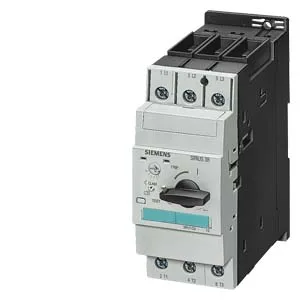
The CLASS 20 trip curve means it allows a 20-second cold-start inrush before tripping, which covers most standard squirrel-cage induction motors without nuisance trips on startup.
Breaking capacity — what it can interrupt
This breaker handles fault current up to 100 kA at 240 V AC, 50 kA at 400 V, 12 kA at 500 V, and 5 kA at 690 V.
The main circuit uses screw-type box terminals accepting 2x (0.75...25 mm²) stranded or 1x (0.75...35 mm²) — plenty of room for the motor feed. Auxiliary and control circuit terminals are also screw-type, taking 2x (0.5...1.5 mm²) solid or 2x (0.75...2.5 mm²) stranded. Zero clearance needed at the sides or back, so you can pack these tight on the rail. IP20 on the front keeps fingers out; fine for a closed panel.
What it doesn't do
No ground-fault detection built in — if you need that, you'll add a separate module or use a different frame. Phase-failure detection is present, which is standard for motor protection: if one phase drops out, the breaker trips before the motor single-phases and burns up. The auxiliary switch is a transverse design, and the product accepts an auxiliary switch extension if you need remote status indication.