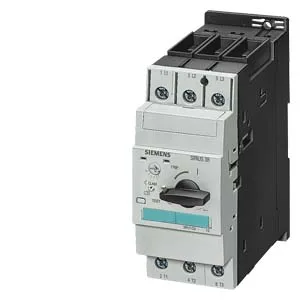
Rated 18.5 kW at 400 V AC with a breaking capacity of 50 kA at 400 V and 100 kA at 240 V, this breaker handles fault currents up to those levels without cascading upstream — critical for panel SCCR compliance under IEC 60947-2.
Snaps onto 35 mm DIN rail per DIN EN 50022; screw and snap-on fastening method means no tools needed for the rail, but the main circuit terminals are screw-type with box terminals accepting 2x (0.75... 25 mm²) stranded or 1x (0.75 … 35 mm²) — expect a screwdriver for the power side. Auxiliary and control circuit terminals are also screw-type, accepting 2x (0.5... 1.5 mm²) solid or 2x (0.75... 2.5 mm²) solid — keep the strip length clean to avoid stray strands under the clamp. Dimensions are 55 mm wide by 140 mm tall by 149 mm deep — the 149 mm depth means it projects nearly 15 cm from the DIN rail, so check gland plate clearance if the enclosure is shallow.
RoHS compliance date is July 1, 2006 — the part meets the original RoHS directive, and the substance prohibition date is on record for compliance documentation.
Ratings and Environment
Shock resistance rated at 25 g for 11 ms — survives most panel vibration and transport bumps without nuisance tripping. Auxiliary switch is transverse design and the product extension supports an auxiliary switch — the transverse orientation means the switch block mounts alongside the breaker body, not stacked on top. Maximum operating frequency in AC-3 duty is 15 operations per hour — fine for manual or infrequent motor starts, not for high-cycle jogging applications.