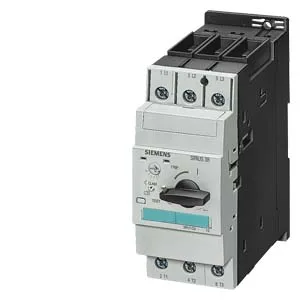
It protects a 22 kW motor at 400 V and interrupts faults up to 50 kA at that voltage, so it handles high-fault-capacity industrial feeders without cascading upstream breakers. Three-pole design, screw-type box terminals for the main circuit, and separate screw terminals for auxiliary/control wiring. Accepts solid wire 2x (0.75 to 16 mm²) and stranded up to 2x (0.75 to 25 mm²), plus a single 35 mm² conductor.
Trip Class and Motor Protection
No ground-fault detection on this variant — the 3RV1031-4HA10-ZW95 handles overload and short-circuit only. If ground-fault protection is needed, pair it with a separate ground-fault relay or choose a different SIRIUS order code.
Rated breaking capacity: 100 kA at 240 V AC, 50 kA at 400 V AC, 10 kA at 500 V AC, 4 kA at 690 V AC. At 400 V — the most common industrial motor voltage — the 50 kA figure gives ample headroom for high-fault installations, allowing selective coordination with downstream contactors and upstream feeders. Surge voltage resistance rated at 6 kV.
Shock rated at 25 g for 11 ms — survives rough handling during panel assembly and transport.
Main circuit screw-type box terminals accept solid 2x (0.75 to 16 mm²), stranded 2x (0.75 to 25 mm²), and a single stranded conductor up to 35 mm². For fine-stranded wire with ferrules, the range is 2x (0.75 to 16 mm²) or a single 0.75 to 25 mm². AWG equivalents: 2x (18 to 2) solid, 1x (18 to 2) for the single conductor. Auxiliary and control circuit terminals are screw-type as well, and the breaker accepts an auxiliary switch extension — order the switch module separately if remote status indication is needed.
Power Loss and Duty Cycle
Total power loss in hot operating state is 29 W; per-pole loss is 9.7 W. At AC-3 duty the maximum switching frequency is 15 operations per hour — adequate for motor starting cycles on pumps, fans, and compressors, but not for rapid cycling applications like stamping presses.