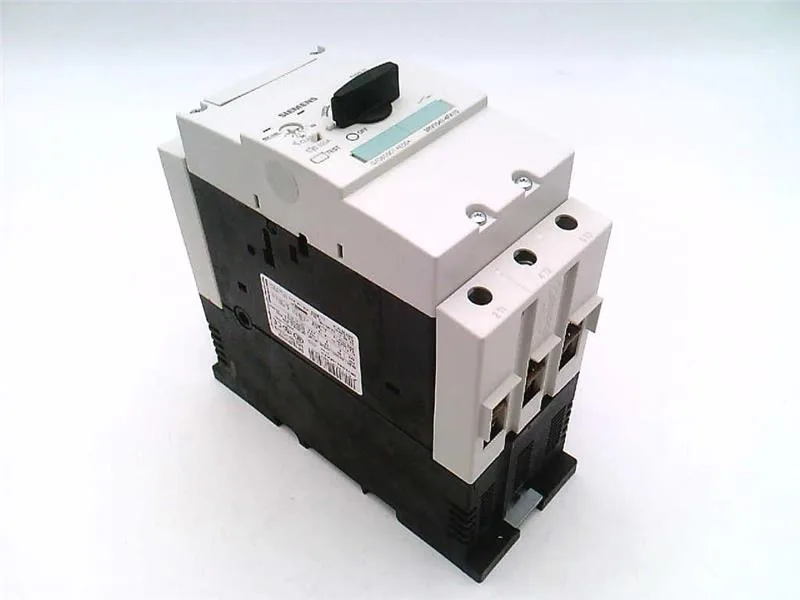
Rated at 690 V, it delivers a breaking capacity of 100 kA at 240 V and 400 V AC, dropping to 15 kA at 500 V and 7.5 kA at 690 V. At 400 V it handles motor loads up to 30 kW, making it suitable for medium-sized motors on pumps, fans, and compressors.
Any mounting position is allowed, with zero clearance needed at the back or sides — so it fits tight in a crowded panel without derating for side-by-side placement. Dimensions are 70 mm wide, 165 mm high, 174 mm deep — a standard three-pole MCCB footprint that drops into existing SIRIUS or 3RV2/3RV1 panel layouts. Terminals are screw-type with box terminals for the main circuit, accepting solid conductors 2x (2.5... 16 mm²) and stranded 2x (10... 50 mm²) or 1x (10... 70 mm²). AWG equivalents are 2x (10... 1) solid. The auxiliary/control circuit also uses screw terminals. Finely stranded with core-end processing accepts 2x (2.5... 35 mm²) or 2.5... 50 mm².
RoHS compliance is indicated by a substance prohibition date of 07/01/2006, covering the original EU RoHS directive. The auxiliary switch extension (product extension auxiliary switch: Yes) means you can add remote status signaling without a separate contactor block.
Electrical ratings and performance
Shock resistance is 25g for 11 ms, and surge voltage resistance is 6 kV, so it holds up in industrial environments with transient events. Maximum operating frequency in AC-3 duty is 15 operations per hour — fine for motor starting cycles on conveyors or pumps, but not for high-repetition jogging or rapid reversing without derating the duty cycle.