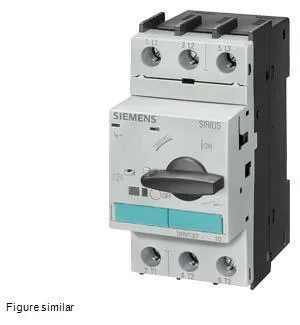
The breaking capacity sits at 100 kA across the board: 240 V, 400 V, 500 V, and 690 V AC — that's a flat 100 kA curve, no derating as voltage climbs, which simplifies coordination studies. At 400 V it's sized for a 0.55 kW motor load. The operating frequency is capped at 15 switching cycles per hour in AC-3 duty, so it's built for occasional starts, not high-cycle jogging.
Zero clearance needed at the back or sides, which helps when packing breakers tight on a gland plate. Screw-type terminals on both main and auxiliary/control circuits accept solid or stranded wire: 2x (1 to 2.5 mm²) or 2x (2.5 to 6 mm²) per clamp, with AWG equivalents of 2x (14 to 10).
The substance prohibition date of 01.05.2012 aligns with RoHS compliance — the part meets the EU RoHS directive effective from that date. No ground-fault or phase-failure detection built in (those are separate protection functions, not integrated here).