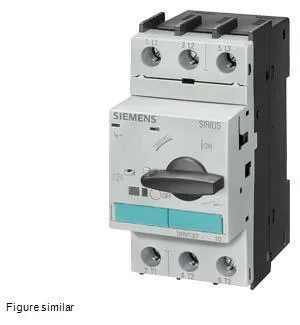
It's rated for 5 A continuous current and delivers the same 5 A in AC-3 duty at 400 V, which means it directly protects a 1.5 kW motor at that voltage — no derating guesswork for a standard 4-pole induction motor. Breaking capacity sits at 100 kA up to 500 V AC, dropping to 6 kA at 690 V — that 100 kA figure covers most industrial fault levels on 400 V distribution, so you're not chasing selective coordination nightmares on a typical line.
Any mounting position works; width is 45 mm. Screw-type terminals on both main and auxiliary circuits accept solid, stranded, or finely stranded wire: 2x (1 to 2.5 mm²) and 2x (2.5 to 6 mm²) per clamp. That covers most panel wiring from 14 AWG up to 10 AWG.
What it doesn't do — and why that matters
This breaker has no ground fault detection and no phase failure detection built in. That's by design for a starter-combination breaker — it relies on the upstream feeder protection or a separate electronic relay for those functions. If your application requires ground fault or phase loss tripping, you'll need to add an external module or specify a different variant. It ships with no auxiliary contacts fitted (0 changeover contacts), but the product extension for an auxiliary switch is ready — you can snap one on without pulling the breaker off the rail. Rated for a maximum of 15 operations per hour at AC-3 — that's fine for infrequent start/stop cycles on a pump or fan, but not for a high-duty reversing application or a jogging station.
Surge voltage resistance rated at 6,000 V. Front carries IP20 protection. Shock resistance tested to 25g for 11 ms — survives the ride on a forklift or a slammed cabinet door.