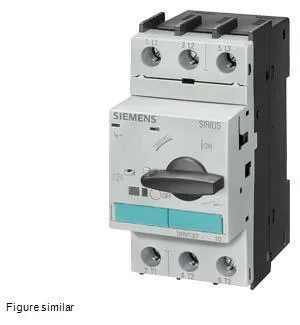
Per the datasheet, it is a 3-pole unit rated 12.5 A continuous current, with a magnetic overcurrent release set non-adjustable at 13 × In for short-circuit protection. Auxiliary contacts are screw-type as well, though the unit ships without auxiliary contact blocks fitted — the provision is there for field addition. The front face carries an IP20 rating, meaning finger-safe access to the operator handle and trip indicator, but the body itself is not sealed against moisture ingress; this is a panel-interior component, not a washdown-duty device.
For a 400 V distribution system with a transformer upstream capable of delivering 85 kA of prospective fault current, this breaker holds coordination. The ratings step down at higher voltages: 100 kA at 240 V, 50 kA at 500 V, and 10 kA at 690 V AC. The magnetic release is fixed at 13 × In, which for a 12.5 A breaker means a magnetic trip threshold of approximately 162.5 A. That is a narrow instantaneous band, typical for motor-starting applications where you want the breaker to ride through inrush but trip fast on a bolted fault. The mechanical endurance is rated at 25,000 operations for the main contacts — a figure that assumes the breaker is switched under load within its AC-3 duty cycle (15 operations per hour maximum at AC-3). Below that switching rate, contact life extends proportionally. Surge voltage withstand is 8,000 V. Shock resistance is 12 g for 11 ms.
The breaker measures 90 mm wide × 130 mm high × 70 mm deep. It mounts via screw fixing. Clearance required is zero mm backwards and zero mm at the side.