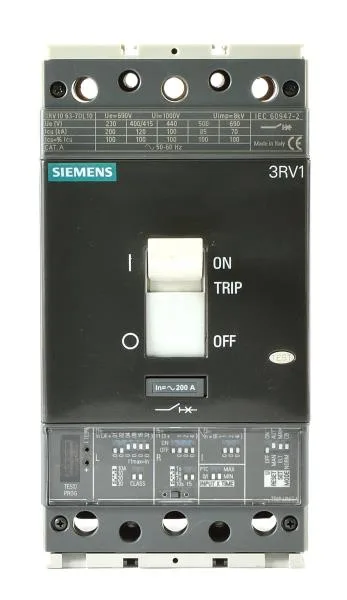
It carries a continuous rated current of 100 A and, in AC-3 duty at 400 V, delivers 100 A operational current for motor loads up to 55 kW.
The AC-3 rating at 400 V (100 A) tells you it's rated for switching induction motors under starting and running conditions, not just resistive loads. The electronic short-circuit trip gives faster response and better selectivity than a thermal-magnetic trip unit, especially on low-level faults where a bimetallic strip might coast. Surge voltage withstand of 8,000 V covers the impulse levels expected in industrial distribution (typically 6 kV impulse for 400 V systems, so this provides margin).
Fastening is by screw fixing — this is a panel-mount device, not DIN-rail snap-on. The dimensions — 205 mm height, 105 mm width, 103.5 mm depth — fit a standard MCCB footprint. Clearance requirements: 0 mm backwards, 0 mm at the side, meaning it can be mounted flush against the back panel and side-by-side with adjacent devices without additional air gap for arc quenching.
Substance prohibition date of 01/08/2008 aligns with RoHS compliance — the part is RoHS-compliant as manufactured after that date. Installation altitude limited to 2,000 m above sea level without derating; above that, dielectric strength and cooling are reduced. Shock resistance of 12g for 11 ms means it survives handling and transport shocks typical in panel shipping. Touch protection is finger-safe, meeting the requirements of IEC 60529 for IP2X protection against accidental contact.