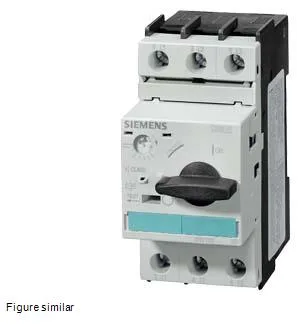
What this SIRIUS breaker does on a transformer branch
The continuous current rated value is 0.32 A, and the trip class is CLASS 10, so it clears a fault fast enough to protect the transformer windings without nuisance tripping on magnetizing inrush. Breaking capacity is a flat 100 kA across the board — at 240 V, 400 V, 500 V, and 690 V AC — which means this breaker can handle a hard fault on a high-capacity distribution panel without upstream coordination headaches. Rated impulse withstand voltage is 6 000 V.
Footprint and mounting — fits a standard DIN rail slot
Width is 45 mm, height 97 mm, depth 96 mm — a single 45 mm module on the DIN rail. Clearance: zero mm backwards and zero mm at the side — no extra air gap needed between adjacent devices on the rail. That keeps the panel fill factor tight.
Termination and wiring — screw terminals, solid and stranded
Solid wire: 2x (0.5 to 1.5 mm²) and 2x (0.75 to 2.5 mm²). Stranded: 2x (1 to 2.5 mm²) and 2x (2.5 to 6 mm²). AWG for main contacts: 2x (14 to 10). Auxiliary and control circuit also screw-type, with a transverse auxiliary switch design. The product extension auxiliary switch is available — the breaker accepts an add-on block.
Environmental and lifecycle — current production, IP20 front
Substance prohibitance date is 01.05.2012 — the part complies with RoHS and REACH requirements effective that date.
Auxiliary contact ratings — what the switch block handles
The auxiliary switch is rated: 1 A at 24 V, 0.5 A at 230 V, and 0.15 A at 60 V. That covers typical PLC input or contactor coil signaling through the breaker's status contacts. Operating frequency at AC-3 is 15 operations per hour maximum — this is a protection device, not a cycled contactor.