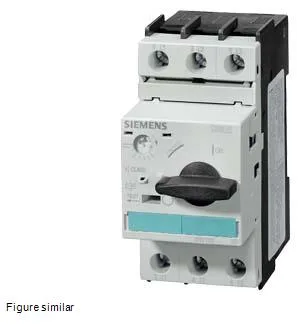
Rated at 1.6 A continuous current and 690 V insulation voltage, it breaks up to 100 kA at 400 V AC, which is enough to clear a bolted fault on the secondary side of a distribution transformer without the arc re-striking. The CLASS 10 trip curve means it will hold through a transformer's magnetizing inrush (typically 8–12× FLA for 0.1 s) but still trip fast enough to protect the winding from a sustained overload.
The 45 mm width and 97 mm height fit a standard 8-module enclosure row; depth of 96 mm means it clears a 100 mm deep gland plate with a few mm to spare. Screw terminals on the main circuit accept solid conductors up to 2x 2.5 mm² or stranded up to 2x 6 mm², which is adequate for the 1.6 A rating but also leaves headroom if you need to parallel feeds. IP20 on the front — fine for a dry indoor panel; keep it out of washdown zones.
The 100 kA breaking capacity holds across the full voltage range — 240 V, 400 V, 500 V, 690 V AC (–). That's a high-rupturing-capacity device, not a standard MCB; it is sized for installation close to a transformer secondary or a high-fault-capacity bus. The 1.6 A continuous rating and the transformer-protection design mean it is intended to protect a small control transformer (e.g., 250 VA at 400 V) or a similar inductive load with a high inrush-to-running ratio. No ground-fault detection — that is a separate device if you need it.