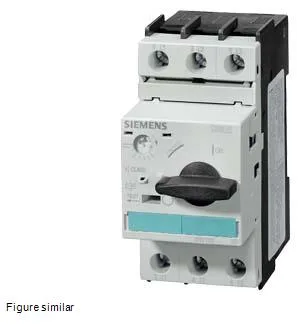
Phase-failure detection is built in. No ground-fault detection on this variant.
Width is 45 mm, height 97 mm, depth 96 mm. Clearance: zero mm backwards, zero mm at the sides — meaning you can butt them tight against the backplane and against adjacent devices without derating. That's unusual for a breaker with 100 kA interrupting capacity; most need side gaps for arc-chamber venting. This one vents forward through the IP20 finger-safe front.
Interrupting capacity and coordination
At 690 V it drops to 6 kA — that's still adequate for most 690 V distribution, but if your transformer secondary is at 690 V and the available fault current exceeds 6 kA, you need an upstream current-limiting device. The surge voltage withstand is 6 kV, which covers typical IEC 60947-2 impulse coordination for 400 V systems. Rated operational voltage for AC-3 switching duty is 690 V maximum. Operating frequency at AC-3 is 15 operations per hour max — that's a protection device, not a contactor; it's meant to stay closed except during fault or maintenance isolation.
Main circuit and auxiliary/control terminals are screw-type. Solid wire: 2x 1 to 2.5 mm² or 2x 2.5 to 6 mm². Stranded: same ranges. Finely stranded with ferrule: same again. AWG equivalent: 2x 14 to 10 AWG.
RoHS compliance date is 01.05.2012, meaning it meets the EU RoHS directive since that date. Shock resistance rated at 25g for 11 ms — that's marine and rail-grade, not just panel-stationary.