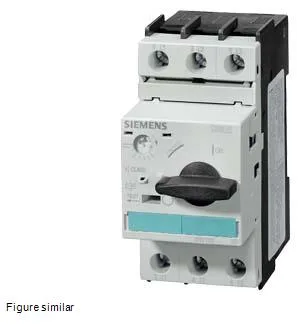
Transformer protection breaker, 10 A, 100 kA — what the ratings mean
Rated 10 A continuous at 400 V, with a CLASS 10 trip class — the breaker opens within 10 seconds at 7.2× rated current, which is the standard for motor and transformer starting duty where the overload is brief but high. Breaking capacity hits 100 kA at 240 V and 400 V, drops to 42 kA at 500 V, and 6 kA at 690 V. No ground fault detection on this variant.
Mounting and wiring — DIN rail, screw terminals, 45 mm wide
At 45 mm wide, it occupies a single modular slot — fits standard panel layouts without crowding adjacent devices. Main circuit terminals are screw-type, accepting solid conductors 2x (0.5 to 1.5 mm²) or 2x (0.75 to 2.5 mm²), and stranded 2x (1 to 2.5 mm²) or 2x (2.5 to 6 mm²). The auxiliary switch uses transverse design with 0 auxiliary contacts on this variant. Suitable for dry indoor panels only. Depth 96 mm, height 97 mm. Any mounting position allowed. Shock rated at 25g for 11 ms.
Lifecycle and sourcing — current production, quoted to order
Mechanical endurance rated at 100 000 cycles typical for the main contacts. Electrical endurance depends on switching frequency and load; at AC-3 duty the maximum switching rate is 15 operations per hour.
Delta vs. 3RV2021-1FA15 — what changes
The 3RV2021-1FA15 is a newer-frame sibling in the SIRIUS series. Both are 45 mm wide, DIN-rail mounted, and offer 10 A at 400 V with 100 kA breaking capacity. The 3RV2021-1FA15 uses spring-cage terminals instead of screw terminals on the main circuit — a difference in wiring preference, not in electrical rating. Panel cutouts and rail spacing are identical; a swap requires re-terminating but no enclosure modification.