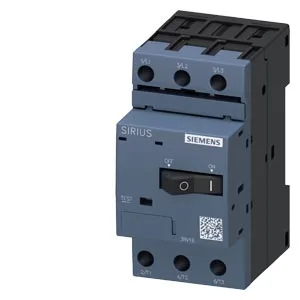
It's not a standard motor protection breaker; the design is for fuse monitoring. Rated operational voltage spans 20 to 690 V, and it delivers a 100 kA breaking capacity at 240 V, 400 V, 500 V, and 690 V AC — that's the kind of fault current you'd see on a large industrial distribution board, not a light commercial panel. It includes phase failure detection, so if one fuse blows on a three-phase line, the breaker sees the missing phase and opens — preventing single-phasing damage to motors or transformers downstream. No ground fault detection on this unit.
Size S00 frame — that's the smallest SIRIUS frame, so it fits in tight DIN-rail enclosures. Any mounting position works. Clearances: 20 mm above and below, 9 mm to the side, zero forward or backward clearance needed. That zero forward clearance is handy when you're packing breakers tight against a gland plate. Screw terminals for the main circuit accept 2x (0.5 to 1.5 mm²) or 2x (0.75 to 2.5 mm²) solid or stranded wire, M3 screws on the main contacts.
Operating conditions and ratings
Operates at -20 to +60 °C; stores or ships at -50 to +80 °C. That -20 °C floor is fine for a heated electrical room but borderline for an unheated North Sea pump house — plan the enclosure heater accordingly. Maximum switching rate at AC-3 or AC-3e duty is 15 operations per hour. That's typical for a fuse-monitoring breaker that only operates on fault events, not a frequent switching device like a contactor. At 480 V and 600 V the rated current drops to 0.2 A — that's unusual and likely reflects the fuse-monitoring sense circuit, not the main path. The main breaking capacity stays at 100 kA across the voltage range up to 690 V (-).