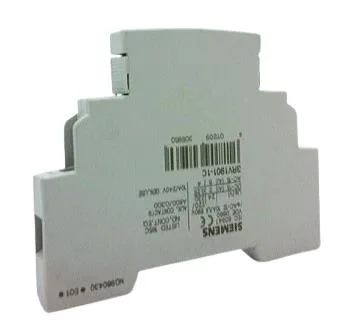
The Siemens SIRIUS 3RV1901-2C is a lateral auxiliary switch designed to snap onto the side of circuit breakers in sizes S00, S0, S2, and S3. It adds two normally-closed (NC) instantaneous auxiliary contacts to the breaker, giving the panel designer a way to signal the breaker's tripped or open state back to a PLC, safety circuit, or status lamp without running separate wiring to the main contacts. The spring-loaded terminals accept 2x (0.5... 2.5 mm²) solid or stranded wire, or 2x (0.5... 1.5 mm²) with core-end ferrules, and the plug-in fixing means it clips onto the breaker body without tools — a time-saver on a build bench or during a turnaround swap.
The 10 A maximum rating is the thermal continuous current the switch can carry through its closed NC contacts. That's the limit for the circuit you're switching — stay under it for the load side. The AC-15 rating at 690 V is 1 A, which is the inductive load rating for solenoid valves or contactor coils at that voltage; AC-15 is the standard category for electromagnetic loads with inrush. The voltage-specific ratings — 2 A at 24 V, 0.5 A at 110 V, 0.25 A at 220 V, 4 A at 230 V, 3 A at 400 V, 10 A at 690 V (–) — map to the actual current the contacts can break at those voltages. For a 24 VDC PLC input, you're good for 2 A; for a 230 VAC contactor coil, 4 A gives headroom. The 2 NC contact count means the switch provides two independent break-before-make circuits — useful for dual-channel safety inputs or redundant status feedback.
The plug-in fixing clips directly onto the side of the breaker body — no DIN-rail space consumed beyond the breaker itself. The spring-loaded terminals accept 2x (0.5... 2.5 mm²) solid or 2x (0.5... 1.5 mm²) with ferrules, which covers standard control wiring. The AWG equivalent is 2x (20... 14). No screwdriver torque to set; strip to 8–10 mm and push in. The switch sits flush against the breaker, so the overall width of the breaker-plus-switch assembly stays within the same DIN-rail pitch as the breaker alone.