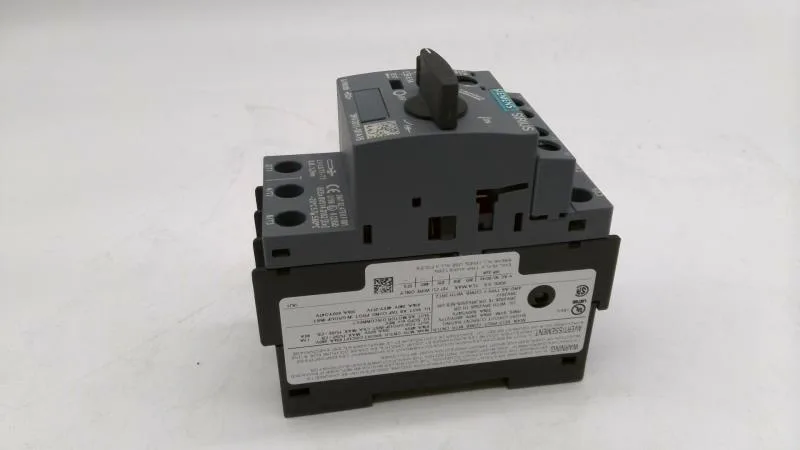
It is a current-production part (lifecycle stage: current). Rated for operating voltages from 20 to 690 V, it delivers a breaking capacity of 100 kA at 400 V, 500 V, and 690 V — meaning it can safely interrupt fault currents up to that level without cascading upstream, which is critical for selectivity coordination in a distribution panel. Trip class is CLASS 10, so it disconnects within 10 seconds under locked-rotor conditions — standard for general-purpose motor starting on pumps, fans, and conveyors where the load accelerates quickly. Ground fault detection is not included (no) — that would require an add-on module or a separate ground-fault relay.
The 45 mm width (three module spaces) fits standard panel layouts. Any mounting position is allowed, which simplifies cabinet layout. Terminals for the main current circuit are screw-type, accepting 2x (0.5 to 1.5 mm²) solid or stranded, or 2x (0.75 to 2.5 mm²). The main contact screws are M3. Clearance distances: 50 mm upwards and downwards, 30 mm at the sides, 0 mm forwards and backwards — these are the minimum free air gaps around the breaker to maintain rated performance and avoid heat buildup.
Environmental and operating limits
The storage range exceeds the operating range — that limit governs handling, not running. Switching frequency for AC-3 and AC-3e duty is 15 operations per hour maximum — adequate for manual or infrequent motor starting, not for high-cycling applications like rapid reversing.
This is a current-production part (lifecycle stage: current). No end-of-life notice or last-time-buy is on record.