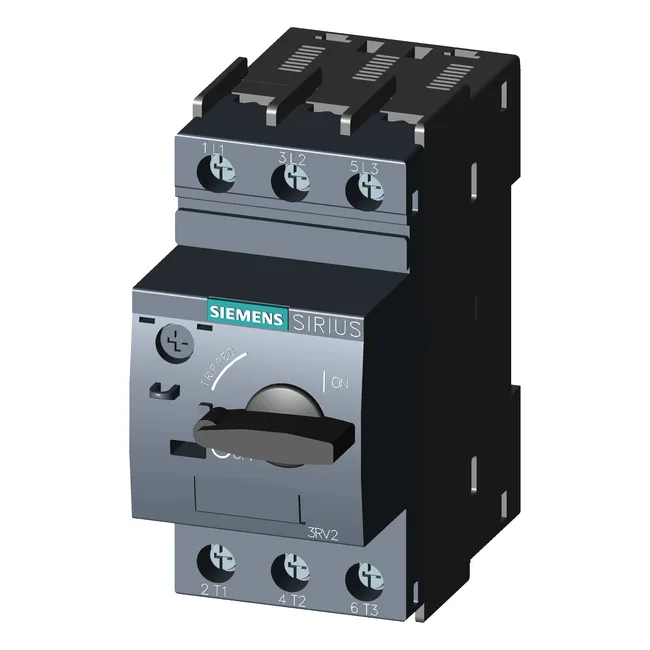
Motor protection breaker, 100 kA class
Its Trip Class 10 characteristic means it will trip within 10 seconds at 7.2× the thermal setting — standard protection for standard induction motors, not for high-inertia loads that need Class 20 or longer. Rated breaking capacity hits 100 kA at 400 V AC (and also at 240 V, 500 V, 690 V per the spec table). On a three-phase motor, if one phase drops, the breaker opens before single-phasing cooks the winding. This is a standard expectation on motor-rated breakers, but worth confirming if your BOM spec requires it — some economy breakers omit it.
Any mounting position is allowed. Spring-loaded terminals accept 2× (0.5 to 2.5 mm²) solid or stranded copper. Clearance dimensions: 50 mm upwards and downwards, 30 mm at the side, 0 mm forwards and backwards. That 0 mm forward/backward clearance means the breaker can be mounted flush against a panel wall or backplane — no breathing gap needed at the front or rear.
Auxiliary contact ratings are given for several control voltages: 1 A at 24 V, 0.5 A at 120 V, 0.5 A at 125 V, 0.5 A at 230 V, and 0.15 A at 60 V. These are the switching capacities for the built-in auxiliary contacts — useful when sizing the control transformer or verifying the PLC output can drive the breaker's aux circuit.
Environmental range
The temperature compensation is specified over the same -20 to +60 °C operating window, meaning the thermal trip curve stays within tolerance across that span without manual adjustment.