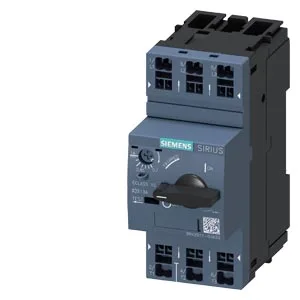
Rated for a breaking capacity of 100 kA at 400 V AC (and also at 240 V, 500 V, and 690 V AC), this breaker can safely interrupt fault currents up to that level without upstream fuses or a larger breaker — a key advantage for panel builders aiming for a high SCCR rating on the feeder. It includes phase failure detection, which will trip the breaker if one phase is lost — preventing single-phasing damage to a three-phase motor. Ground fault detection is not built in; that would require a separate module or a different variant.
Key Ratings and Their Meaning for Fit
The breaker's rated operational voltage spans 20 to 690 V, covering low-voltage motor circuits from 24 V control panels up to 690 V industrial mains. At 230 V, it is rated for 0.2 kW motor load; at 480 V the rated current is 1 A, and at 600 V also 1 A — these are the continuous current ratings at those voltages, not the short-circuit capacity. The screwdriver shaft diameter for terminal screws is 3 mm. This speeds wiring in panel production and reduces the risk of loose connections from vibration.
The 100 kA breaking capacity across multiple voltage levels means this breaker can serve as the main feeder protector in a panel, not just a motor starter component — useful for consolidating part numbers in a build.