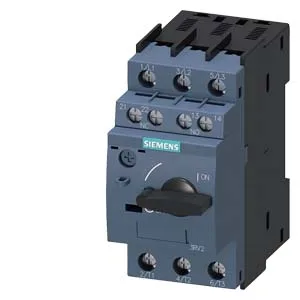
Its Class 10 trip characteristic ensures rapid disconnection on locked-rotor conditions — critical for holding the unit on the grid when a motor stalls and the thermal curve must stay inside the winding damage boundary. Ground fault detection is not included — that requires an add-on module or a separate residual-current device downstream.
Short-circuit ratings and selectivity
The interrupting capacity is 100 kA at 400 V and 500 V, and 10 kA at 690 V. At 240 V it also holds 100 kA. These figures cover most industrial distribution panels up to 690 V line-to-line, provided the available fault current stays within those limits. The 690 V derating to 10 kA is the number to check if the panel feeds a 690 V motor — a 100 kA SCCR at that voltage is not on the table. The gL/gG fuse coordination values are 25 A at 400 V and 500 V, dropping to 20 A at 690 V. That sets the maximum upstream fuse for back-up protection — useful when coordinating with a feeder breaker in a motor control centre.
That 50 mm vertical gap is the one to watch — pack the rail too tight and you lose the arc-chamber venting path.