What it is and what it does
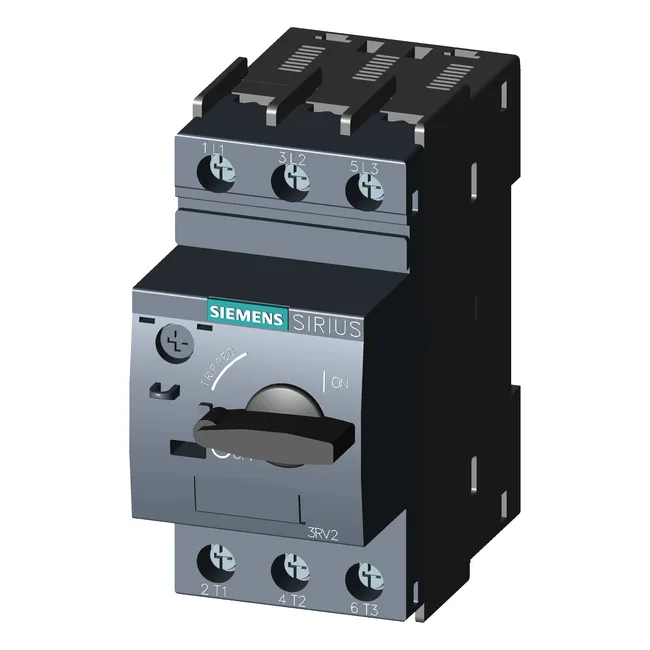
The Siemens 3RV2011-1FA10-ZX95 is a SIRIUS motor protection circuit breaker — the device that sits between the contactor and the motor, combining overload and short-circuit protection in one 45 mm wide package. It's designed for motor protection duty, with a CLASS 10 trip curve that clears overloads fast enough to protect standard induction motors during start-up. Phase failure detection is built in, so a lost phase on the line side won't let the motor single-phase to destruction. The breaker mounts on 35 mm DIN rail per DIN EN 60715, screw and snap-on, and can be installed in any position.
Breaking capacity — the real-world fault handling
The headline number is 100 kA at 400 V — that's the short-circuit current it can safely interrupt without welding contacts or rupturing the case. At 240 V it's also 100 kA, and at 500 V it holds 100 kA. At 690 V the rating drops to 4 kA, which still covers most industrial distribution faults. For the high-fault panels common in North America (65 kA or 100 kA at 480 V), this breaker lands squarely in the main feeder class. The fuse backup ratings are gL/gG 32 A at 400 V and 500 V, and gL/gG 25 A at 690 V — so if you need to coordinate upstream fusing, those are the maximum values.
Motor protection specifics — trip class and detection
CLASS 10 means the overload trip operates within 10 seconds at 7.2× the setting current — fast enough for most NEMA Design B and IEC standard motors. The breaker also detects phase failure, which is a common cause of motor burnout in three-phase systems. Ground fault detection is not included, so if that's required, an external ground-fault module or a different breaker variant is needed. The rated voltage range is 20 to 690 V, covering low-voltage control circuits up to 690 V line supplies.
Mounting and integration — DIN rail, clearances, terminals
Width is 45 mm — three standard module spaces on a DIN rail. Depth is 97 mm, height 97 mm. Clearance requirements: 50 mm upward and downward, 30 mm at the sides, zero forward and backward. That means you can butt it against a back panel or enclosure wall on the front and rear faces, but need breathing room top and bottom for arc quenching and heat dissipation. Screw-type terminals on the main circuit accept 2× (0.75 to 2.5 mm²) solid or stranded, or 2× 4 mm² — M3 screws. Operating temperature range is -20 to +60 °C; storage and transport from -50 to +80 °C.
Lifecycle and sourcing
The lifecycle stage is listed as current — meaning this is an active, in-production part from Siemens. No end-of-life notice or last-time-buy window is indicated. For BOM freeze or volume procurement, the part is sourced and quoted to order against an RFQ through independent distribution; availability and current pricing are confirmed at quote time. Compliance documentation (RoHS, REACH, UL, IEC) is standard for the SIRIUS line and can be provided with the order.
