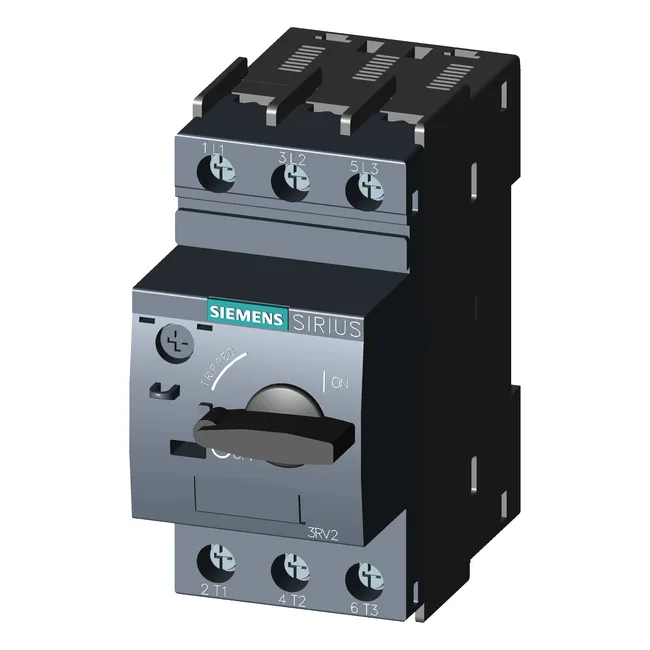
No ground fault detection here — that's a separate add-on if your line needs it. The interrupting ratings tell you where this breaker can sit in the fault hierarchy: 100 kA at 240 V, 30 kA at 400 V, 5 kA at 500 V, 2 kA at 690 V. At 240 V it's a monster — you can put it upstream of a sub-panel and not worry about series rating gymnastics. At 690 V the 2 kA limit means it's fine for most motor branch circuits but check your available fault current if you're feeding from a large transformer. The fuse backup table (gL/gG 80 A at 240 V, 63 A at 400 V, 50 A at 500 V, 40 A at 690 V) gives the maximum upstream fuse that still allows the breaker to clear its rated fault — useful for selectivity coordination studies. Horsepower ratings: 1 hp at 110/120 V, 2 hp at 230 V, 3 hp at 200/208 V, 5 hp at 220/230 V. That covers the common small-motor sizes you'd find on pumps, fans, and small conveyors in a 480 V or 240 V delta panel. The AC-3 maximum switching rate is 15 operations per hour — fine for a start/run/stop cycle, not for jogging or frequent reversing.
Width is 45 mm, depth 97 mm, height 97 mm — that's a standard 2-module-wide footprint on a 35 mm DIN rail per DIN EN 60715. Screw and snap-on mounting: clip it onto the rail, tighten the screw to lock it, no tools for the rail engagement. Mounting position is any, so you can lay it sideways in a shallow enclosure if the gland plate forces that. Terminals are screw-type for the main current circuit, accepting 2x 0.75...2.5 mm² solid or stranded, or 2x 4 mm². Main contact screws are M3. That's enough for the motor branch circuit wiring typical of a 5 hp motor at 230 V. Temperature compensation is active across the full operating range of -20 to +60 °C — the thermal trip curve stays accurate whether the panel is in a conditioned room or a hot pump house.