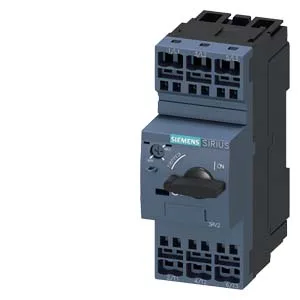
Motor protection circuit breaker for high-fault-current panels
Rated insulation voltage spans 20…690 V, and the breaking capacity holds at 100 kA up through 500 V AC, then steps to 10 kA at 690 V AC. That covers most 400 V and 480 V distribution systems found in industrial plants; the 690 V rating handles mining or marine installations where 690 V is the standard motor voltage. Spring-loaded terminals on the main circuit accept 2× (1…10 mm²) solid or stranded, which covers the typical motor feeder up to about 7.5 kW (10 hp) at 400 V.
Trip class and ambient derating in mill environments
Class 10 trip is the standard for standard-efficiency induction motors; if the motor manufacturer specifies Class 10, this breaker is a direct fit. Operating ambient range is -20…+60 °C, which takes the radiant heat near a furnace line or motor control center without derating the thermal trip curve — a common concern when the MCC sits close to the process. Storage and transport range extends to -50…+80 °C, so the part survives warehouse extremes and unheated shipping containers. The 45 mm width (3 module spaces on a DIN rail) leaves room for a contactor and overload relay in the same enclosure — tight for a 100 kA rated device.