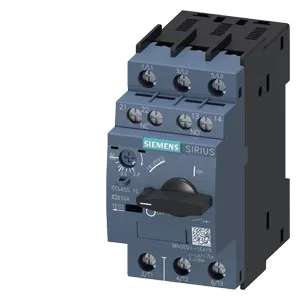
The Siemens SIRIUS 3RV2021-1EA15 is a motor protection circuit breaker, designed for motor protection duty. It's built to sit on a 35 mm DIN rail per DIN EN 60715, using either screw or snap-on mounting — no adapter plate needed. Trip Class 10 means it will trip within 10 seconds at a cold start under locked-rotor conditions, which is the standard match for standard induction motors up to about 15 starts per hour (AC-3 maximum). That 15 1/h figure is the mechanical limit for the contact system, not a thermal limit — stay under it on frequent reversing or jogging duty. Breaking capacity is 100 kA at 240 V, 400 V, and 500 V — that's the full rated short-circuit current it can interrupt without welding contacts or rupturing the case. At 690 V it drops to 4 kA, so if your panel feeds a 690 V motor from a high-fault transformer, you need to verify the available fault current at that voltage. Phase failure detection is built in — if one phase drops out, the breaker trips. That's the difference between a motor burning up on single-phasing and a controlled shutdown. No ground fault detection on this variant; if you need that, you're looking at a different order code in the 3RV2 family.
Footprint & panel fit
Width is 45 mm, depth 97 mm, height 97 mm. That's a single 45 mm module on the DIN rail, so it takes up one slot in a standard enclosure layout. The 45 mm width matches the SIRIUS 3RV2 compact frame — same footprint as the 3RV2021-1FA15 and 3RV2021-1GA15 siblings. Mounting position is any orientation, which simplifies panel layout. Clearance requirements: 50 mm above and below for heat dissipation, 30 mm to the sides, zero forward or backward clearance needed. That 50 mm vertical gap is the one to watch — stack these breakers tight and you'll cook the bimetal trip.
Environment & connections
Operating temperature range is -20 to +60 °C, storage and transport -50 to +80 °C. If your panel sits next to a furnace or in a desert switchroom, the upper end is the limit; above 60 °C ambient you need to derate or move the breaker outside the hot zone. Main circuit terminals are M4 screw-type, accepting 2x (0.5 to 1.5 mm²) solid or stranded, or 2x (0.75 to 2.5 mm²). That covers most motor feed wiring up to about 4 mm² per phase. The auxiliary contact ratings: 1 A at 24 V, 0.5 A at 120/125/230 V, but only 0.15 A at 60 V — that 60 V figure is the weak point if you're switching a 60 VDC control circuit.
