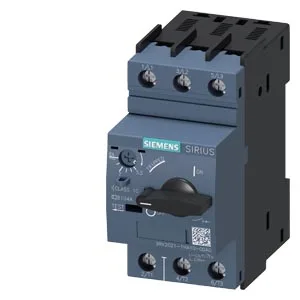
What this SIRIUS breaker does on the line
The Siemens SIRIUS 3RV2021-1HA10-0DA0 is a circuit breaker designed for system protection — meaning it sits upstream of motor starters and contactors to limit fault energy, not to provide direct motor overload protection (that's what the matching 3RV20 overload relay does). The screw-type terminals accept up to 10 mm² stranded wire, so it's comfortable for panel feeders up to that size. At 690 V AC it still holds 6 kA, which covers most industrial motor branch circuits. The SCCR drops to 42 kA at 500 V, so if your panel is fed from a 480 V transformer secondary, you've still got a solid 42 kA of fault clearing. Trip Class 10 means the thermal bimetal trips within 10 seconds at 7.2× rated current — standard for standard-duty motor starting where the acceleration time is under 10 seconds. If you've got a high-inertia load (centrifuge, large fan) that takes longer to spin up, you'd want a Class 20 or 30 trip curve instead. This one is for the normal case.
Mounting and fit — the panel-builder view
Width is 45 mm, depth 97 mm, height 97 mm. That's a single 45 mm module on the DIN rail — same footprint as a standard miniature circuit breaker, but this is a full-size motor-protective device. So you can stack these tight side-to-side, but need breathing room vertically for arc chute venting. Screw terminals for the main circuit take M4 screws. The screwdriver shaft needs to be 5 to 6 mm diameter, Pozidriv size 2 tip. Wire capacity: 2 × (1 to 2.5 mm²) or 2 × (2.5 to 10 mm²) solid or stranded. That's enough for a 4 mm² or 6 mm² motor feeder in most cases.
Operating conditions and ratings
Rated operational voltage range is 20 to 690 V — covers everything from 24 V control circuits up to 690 V industrial mains. At 230 V it's rated for 1.5 kW motor power. The maximum switching frequency in AC-3 duty is 15 operations per hour, so it's not a high-cycling device; for frequent starts you'd need a contactor with a higher mechanical life. That's standard industrial range — fine for unheated enclosures in temperate climates, but if the panel sits in a 50 °C boiler room, derate the continuous current per the manufacturer's curve (not provided here, but standard practice).