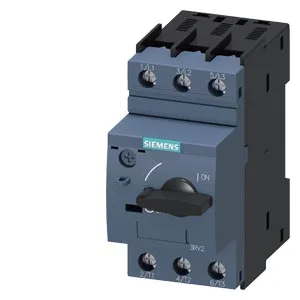
The Siemens 3RV2021-1JA10-0DA0 is a SIRIUS circuit breaker designed for system protection — meaning it protects downstream wiring and components from short circuits and overloads, not just a single motor. At 690 V AC the breaking capacity drops to 6 kA, so coordination studies at higher voltages need attention. This is a Size S0 frame, which is the compact footprint in the SIRIUS range. The 45 mm width means it occupies one standard 45 mm module slot on the rail.
That is high enough for most industrial main distribution panels; you would typically only need a higher SCCR for large transformer-fed switchgear. At 500 V AC the rating is 42 kA, and at 690 V AC it is 6 kA — so if your system runs at 690 V, verify the available fault current is under 6 kA. The motor power rating at 230 V AC is 2.2 kW — that is the maximum three-phase induction motor this breaker can protect in AC-3 duty (starting and stopping under load). The maximum switching rate is 15 operations per hour in AC-3, which is fine for a pump or conveyor that cycles a few times an hour, but not for a high-cycle application like a press or stamping machine.
The main circuit terminals are screw-type, accepting 2x 1 to 2.5 mm² or 2x 2.5 to 10 mm² solid or stranded wire. The screwdriver shaft needs a diameter of 5 to 6 mm, with a Pozidriv size 2 tip. The clearance requirements are 50 mm upward and downward, 30 mm to the side, and zero forward or backward — so it fits flush against the back panel.