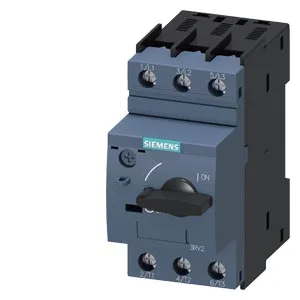
The 100 kA interrupting capacity at 400 V AC (and 240 V AC) means this breaker can safely clear a fault up to 100,000 amps without blowing apart or welding its contacts shut. That's the kind of SCCR you need when the breaker sits close to a large transformer or a high-capacity bus — it lets you avoid adding a separate current-limiting fuse upstream. If one phase drops out, the breaker trips — that's critical because a three-phase motor running on two phases will draw high current in the remaining windings and burn out quickly. Not all motor-protection breakers include this; some rely on the overload relay downstream. The 97 mm height leaves room for the line and load terminals without crowding the next device.
No NRND or phase-out notice has been issued.
Mounting position any — no derating needed for horizontal or inverted rail orientation. The terminals accept 2x 1–2.5 mm² or 2x 2.5–10 mm² solid or stranded wire. Main contact screw terminals are M4. Clearance space: 50 mm upward and downward, 30 mm at the sides, 0 mm forward and backward (–). That's tighter than many breakers — you can pack devices close on the rail without needing extra breathing room behind or in front of the panel door.
Environmental and voltage range
The rated voltage range is 20 to 690 V. Switching frequency at AC-3 duty is 15 operations per hour maximum — that's typical for a motor protection breaker used in start/stop cycles, not for high-speed jogging or reversing applications where a contactor handles the duty.