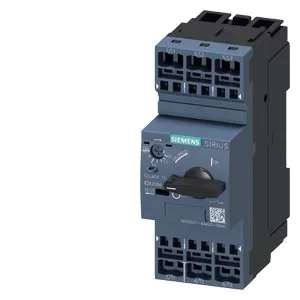
The interrupting ratings are given for both ultimate (Icu) and service (Ics) breaking capacity across voltages. At 400 V AC, the rated ultimate breaking capacity is 25 kA, and the service breaking capacity is 55 kA — the higher Ics figure at the same voltage indicates this breaker can clear faults repeatedly without derating, which matters for high-fault locations like motor control centers fed by large transformers. At 240 V AC, the Icu is 100 kA and Ics is 100 kA, so it holds up even on low-voltage distribution with high available fault current. The gG fuse backup ratings are also specified: at 400 V, the maximum gG fuse is 63 A; at 500 V it drops to 50 A; at 690 V to 40 A. These values define the upstream fuse limit for selective coordination. Ground fault detection is not included; that function would need an external residual-current device or a separate ground-fault relay.
The spring-loaded terminals are the main-circuit connection type. The screwdriver shaft diameter is 3 mm, and the tip size is 3.0 x 0.5 mm — a standard Pozidriv or slotted bit. Clearance distances: 50 mm upwards, 50 mm downwards, 30 mm at the sides, and 0 mm forwards and backwards. The zero forward/backward clearance means the breaker can be mounted flush against the back panel or enclosure wall, saving depth in shallow enclosures.