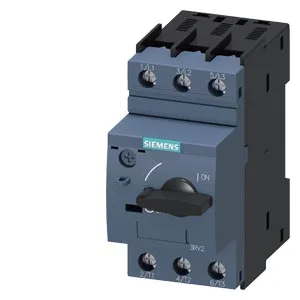
Motor protection circuit breaker for panel integration
The Siemens SIRIUS 3RV2021-4CA10-ZW97 is a motor protection circuit breaker designed for protecting three-phase motors against overload and short-circuit. It snaps onto 35 mm DIN rail per DIN EN 60715 and is rated for any mounting position, giving panel builders flexibility in enclosure layout. Trip class CLASS 10 means it disconnects within 10 seconds at a locked-rotor current of 7.2× the setting current — fast enough to protect standard IEC motors from overheating during a stall. Phase failure detection is built in; ground fault detection is not, so downstream RCD or residual current monitoring is needed where ground-fault protection is required.
Breaking capacity and coordination
At 240 V the interrupting rating is 100 kA; at 400 V it drops to 25 kA; at 690 V it holds at 2 kA. These figures define the available fault current the breaker can safely clear — for a 400 V panel with a transformer rating above 1 MVA, the 25 kA SCCR is typically adequate, but verify against your point-of-supply short-circuit capacity. The gL/gG fuse backup ratings at 400 V (63 A), 500 V (50 A), and 690 V (50 A) tell you the maximum upstream fuse that still allows the breaker to coordinate — exceeding these means the fuse may not clear before the breaker's internal contacts weld.
DIN rail fit and terminal sizing
Width 45 mm, depth 97 mm, height 97 mm. Clearance: 50 mm above and below, 30 mm at the sides, zero forwards and backwards — meaning the breaker can be mounted flush against a backplate or gland plate without extra breathing space for cooling. That's tight for a motor-protection device; verify that the cable bend radius and terminal access don't require more than the stated forwards clearance. Main-circuit terminals accept 2×(1…2.5 mm²) or 2×(2.5…10 mm²) solid or stranded copper, M4 screw terminals. That covers standard motor cable sizes up to 10 mm² — enough for a 15 hp motor at 460/480 V.
