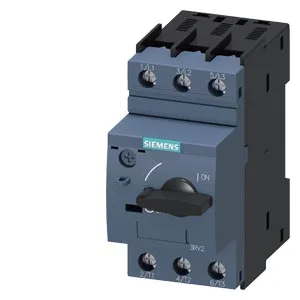
SIRIUS 3RV2021-4EA10-ZX95 — Motor Protection Circuit Breaker
The Siemens SIRIUS 3RV2021-4EA10-ZX95 is a motor protection circuit breaker designed for protecting induction motors against overload and short-circuit. It is part of the SIRIUS family, a modular system for control panels. The CLASS 10 trip class means it will trip within 10 seconds at 7.2× the thermal setting current, which is the standard for standard-duty motor starting — it handles normal acceleration without nuisance tripping but clears quickly on a stalled rotor. Rated for a breaking capacity of 100 kA at 240 V and 25 kA at 400 V, this breaker can handle high available fault currents common in industrial distribution panels. The 25 kA at 400 V is the figure that governs most European 400 V line-side installations — it means the breaker can safely interrupt a fault up to that level without needing an upstream current-limiting fuse for coordination. Phase failure detection is built in — if one phase drops out, the breaker trips, preventing single-phasing damage to the motor. That is a standard requirement for motor protection in most industrial codes.
Mounting and Integration
Mounts via screw fixing or snap-on onto 35 mm DIN rail per DIN EN 60715. The 45 mm width (3-module) fits standard enclosure cutouts. Any mounting position is allowed, which simplifies panel layout. Clearance: 50 mm above and below, 30 mm to the side, 0 mm forward and backward — so it can sit flush against a backplate. Main contact terminals are M4 screw-type, accepting 2×(1…2.5 mm²) or 2×(2.5…10 mm²) solid or stranded wire. That covers most motor feeder cables up to 10 mm².
Key Ratings and So-What
The gL/gG fuse coordination ratings are 63 A at 400 V, 500 V, and 690 V. That means the upstream fuse can be sized up to 63 A gL/gG and still provide backup protection — useful when coordinating with a larger feeder breaker. Maximum switching rate is 15 operations per hour at AC-3 (motor starting) duty. That is typical for a motor-protective device — adequate for most pump, fan, and conveyor cycles, but not for high-repetition jogging or rapid reversing. Operating temperature range is -20 to +60 °C, storage/transport -50 to +80 °C. The storage range exceeds operating — that limit governs handling and warehousing, not running conditions.
