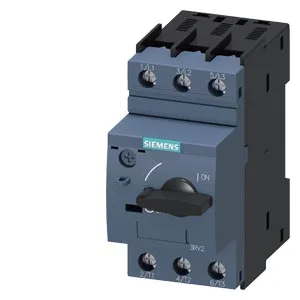
It is rated for a supply voltage range of 20 to 690 V and carries a Trip Class 10 characteristic, meaning it will trip within 10 seconds at 7.2× the thermal setting — the standard for standard-duty motor starts where the rotor is not locked for long. Breaking capacity is 25 kA at 400 V, 100 kA at 240 V, and 2 kA at 690 V, so it handles typical industrial fault levels on a 400 V distribution system without needing an upstream fuse for coordination up to that current. At 480 V the continuous current rating is 28 A, and at 600 V it is also 28 A — the same thermal element covers both voltages. Horsepower equivalents are 5 hp at 230 V, 10 hp at 220/230 V, and 20 hp at 460/480 V, which aligns with common NEMA motor frame sizes.
Mounting and wiring clearances
The screw-type main terminals accept 2×(1…2.5 mm²) or 2×(2.5…10 mm²) solid or stranded copper, with M4 screws for the main contacts. That covers most motor feeder cables up to about 10 mm².
What it detects — and what it doesn't
Ground fault detection is not included; that would require an external ground-fault module or a separate GFCI breaker. The maximum switching rate under AC-3 duty (motor starting) is 15 operations per hour, and the same under AC-3e.