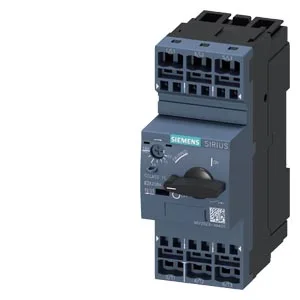
It also detects phase failure, so if you lose a phase upstream, the breaker opens before the motor single-phases and burns up. That's a real line-down saver in the field.
Mounting and wiring — what fits in the panel
Any mounting position works, which helps when you're cramming components into a tight enclosure. Width is 45 mm, depth 97 mm, height 119 mm — that's a standard S0 footprint. If you're replacing an existing S0 breaker, this drops in without drilling new holes or shifting the rail. Control terminals require a 3 mm diameter screwdriver tip. That's tighter than some older breakers, so check your existing panel layout before you assume it fits.
Electrical ratings — the numbers that matter for the BOM
Rated continuous current is 16 A at both 480 V and 600 V — that's the current it will carry all day without tripping on thermal overload. For motor applications, it covers up to 10 hp at 460/480 V and 10 hp at 575/600 V, or 5 hp at 220/230 V. Backup fuse requirements: at 400 V, use a gG 63 A fuse; at 500 V, gG 50 A; at 690 V, gG 40 A. These are the maximum fuse ratings for coordination — don't go larger or you lose the short-circuit protection. Rated insulation voltage is 20 to 690 V. Maximum AC-3 switching voltage is 690 V. Switching frequency: maximum 15 operations per hour under AC-3 and AC-3e duty. That's fine for a motor start every four minutes — not for a rapid-cycle application like a stamping press.