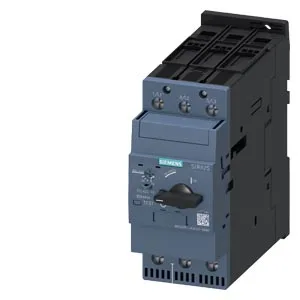
It combines a circuit breaker and overload relay in one device, saving panel space and wiring time over a separate breaker-plus-overload combination. At 230 V it's rated 100 kA, and at 690 V it still holds 4 kA — so it's suitable for 400 V lineups without worrying about upstream fuse coordination. Temperature compensation is active from -20 to +60 °C, keeping the thermal curve accurate across the panel's ambient range.
Any mounting position is allowed, so it fits in tight enclosures or vertical bus risers. At 55 mm wide and 149 mm deep, the S2 frame takes up one standard 55 mm module on the rail. Clearance requirements are 50 mm above and below, 10 mm to the side — plan your gland plate and wireway accordingly. Main circuit terminals accept up to 2× 35 mm² or 1× 50 mm² solid/stranded copper. Use a Pozidriv size 2 bit with a 5–6 mm shaft diameter for the screw terminals — torque spec isn't listed here, but M6 studs on the main contacts suggest a standard 6–8 Nm range typical for this frame size.
Backup fuse coordination
When the available fault current exceeds the breaker's rated breaking capacity, you need backup fuses upstream. At 400 V, a gG 160 A fuse is required; at 500 V step down to gG 125 A, and at 690 V to gG 100 A. At 240 V no backup fuse is needed — the breaker's 100 kA rating covers virtually any service entrance.