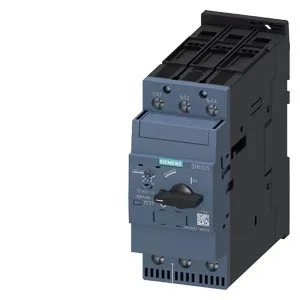
Rated for motor duty at 22 kW at 230 V, 20 hp at 200/208 V, 25 hp at 220/230 V, and 50 hp at 460/480 V, this breaker covers a broad range of three-phase motor sizes commonly found on pumps, conveyors, and fans in industrial panels.
The interrupting ratings are voltage-dependent: 65 kA at 240 V, 30 kA at 400 V, 5 kA at 500 V, and 2 kA at 690 V. At 400 V — the most common industrial supply in Europe and much of Asia — the 30 kA figure gives solid headroom for most panel SCCR requirements. At 690 V the 2 kA rating is lower; if your fault current at that voltage exceeds 2 kA, you'll need an upstream current-limiting device to coordinate. There is no ground-fault detection, so if you need that, plan on an external GF relay.
The 55 mm width and 149 mm depth are standard for this SIRIUS frame size. That means you can pack breakers side-by-side without side gaps, but you need breathing room top and bottom for heat dissipation and arc clearance. Screw-type terminals on the main circuit accept 2×(1–35 mm²) or 1×(1–50 mm²) solid or stranded copper. Torque to M6. That's generous wire range — covers everything from control-circuit taps up to motor feeder cables for a 50 hp motor.