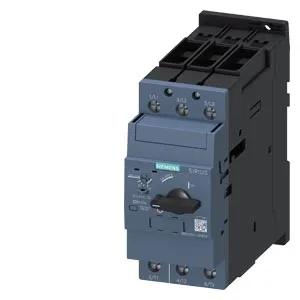
Trip Class 20 means it allows a 20-second cold-start lock-rotor current before tripping — standard for general-purpose conveyors, pumps, and fans that don't need the fast reaction of Class 10. Ground fault detection is not included — that's handled separately by a GFCI or RCD upstream.
Mounts in any position. Screw-type terminals on the main circuit accept 2x 1–25 mm² or 1x 1–35 mm² solid/stranded — M6 for the main contacts. At 240 V no side clearance is required.
Short-circuit breaking capacity varies by voltage: 100 kA at 240 V, 30 kA at 400 V, 5 kA at 500 V, and 2 kA at 690 V. At 480 V it's rated 36 A continuous; at 600 V also 36 A. This lets you coordinate with upstream MCCBs or fuses for selective tripping on most 480 V industrial panels. Maximum switching frequency in AC-3 duty is 15 operations per hour — fine for occasional start/stop cycles, not for high-duty jogging or reversing applications.