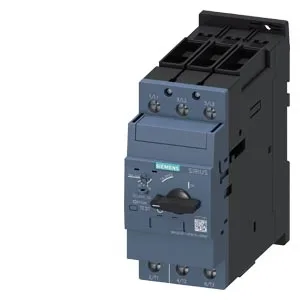
Trip Class 20 means it allows a 20-second hot-start locked-rotor time before tripping — standard for most general-purpose motor starters where the load has moderate inertia, like pumps, fans, and compressors. Rated operating voltage spans 20 to 690 V, with breaking capacities that scale with voltage: 50 kA at 240 V, 30 kA at 400 V, 5 kA at 500 V, and 2 kA at 690 V. Under AC conditions, the same breaker delivers 50 kA at 240 V AC, 50 kA at 400 V AC, 10 kA at 500 V AC, and 4 kA at 690 V AC.
That 10 mm side clearance is tight enough to pack breakers side-by-side in a multi-motor starter panel without wasting rail space. Main circuit terminals are screw-type, accepting 2x 1...25 mm² or 1x 1...35 mm² solid or stranded copper. The screwdriver shaft diameter is 5 to 6 mm, Pozidriv size 2 tip. Main contact terminal screws are M6. Wire the line side through the top terminals, load side out the bottom — standard top-feed practice for motor protection breakers used with contactors downstream.
Operating temperature range from -50 to +60 °C, with temperature compensation active between -20 and +60 °C. That wide operating band covers unheated plant floors in winter and hot cabinet interiors in summer without derating the trip curve. Lifecycle status is current production.