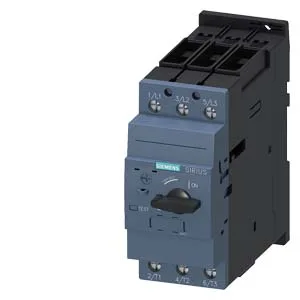
What this SIRIUS breaker does
The interrupting capacity of 30 kA at 400 V and 100 kA at 240 V gives it enough fault-clearing muscle for most industrial distribution panels, so you don't need an upstream fuse for SCCR compliance up to those levels.
The 55 mm width and 149 mm depth mean it occupies one standard 55 mm module slot on the rail — plan your gland-plate clearance accordingly, especially if the panel door has a deep interlock handle.
The Class 10 trip is the one that decides motor protection fit. A Class 10 breaker is designed for motors with short acceleration times — typically pumps, fans, and compressors that reach full speed in under 10 seconds. If your motor has a high-inertia load (flywheel, centrifuge) that takes longer to start, you'd need a Class 20 or 30 breaker to avoid nuisance tripping. The maximum switching frequency at AC-3 duty is 15 operations per hour, which is fine for manual start/stop or contactor-backed control; don't use this breaker as a cycled starter for a rapid-reversing application.