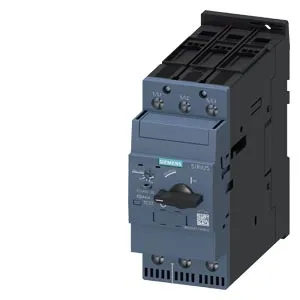
The 55 mm width and 149 mm depth keep the footprint manageable for dense panel layouts. Rated for motor protection duty, it includes phase failure detection — if one phase drops out, the breaker trips before the motor single-phases and burns up. No ground fault detection here, so this is a straightforward motor branch protector, not a combined GFCI. The Trip Class 20 means it allows a 20-second overload before tripping at 7.2× rated current. That's standard for general-purpose induction motors starting conveyors, pumps, and fans — enough inrush time without nuisance trips on normal starts.
At 400 V the 3RV2031-4XB10 interrupts 30 kA symmetrical. On a 480 V system it still carries 59 A continuous and holds a 30 kA interrupt rating at 400 V — check your available fault current against the 30 kA ceiling. The motor switching frequency is limited to 15 operations per hour at AC-3 duty. That is fine for a pump or fan that starts a few times an hour, but not for a jogging application or a reversing drive that cycles every minute.
Mounting and wiring in the field
The snap-on feature means you can clip it onto the rail without tools — useful when retrofitting in a live panel where you want to minimise time with the screwdriver. Screw terminals on the main circuit accept 2× 1–35 mm² or 1× 1–50 mm² solid or stranded wire. M6 terminal screws on the main contacts handle the torque for higher-current connections. That is tight enough for most enclosures — the side gap is the limiting factor if you are packing multiple breakers side by side.