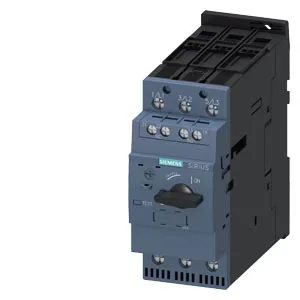
It's designed for motor protection, not general distribution, so the trip curve is tuned to handle inrush without nuisance tripping. Ground fault detection is not included — that's a separate module if your installation requires it. No special adapter needed.
Breaking capacity and trip class — what the numbers mean
For context, most industrial panels downstream of a 1000 kVA transformer see available fault currents in the 25–40 kA range, so 50 kA gives you headroom. That's the standard for standard-duty motor starting — it lets the motor accelerate through inrush but catches a stalled rotor fast enough to avoid winding damage. If your application uses frequent starts or high-inertia loads, you might want Class 10A or 20, but for general-purpose pumps, fans, and compressors, Class 10 is the default. No derating needed for typical plant-floor conditions.
Integration notes
Terminals accept 2×(0.5–1.5 mm²) or 2×(0.75–2.5 mm²) solid or stranded wire. Main contact terminals are M6 — that's a common size for motor circuit breakers in this class, so standard ring lugs fit. Depth is 149 mm, width 55 mm, height 140 mm. That's tighter than some competitors — check your enclosure layout before committing. Maximum switching frequency in AC-3 duty is 15 operations per hour. That's fine for normal process control — a pump cycling on level, a conveyor starting once per minute — but not for rapid jogging or reversing service. If you need high-frequency starting, look at the SIRIUS 3RV2 with auxiliary contact blocks rated for higher mechanical endurance.