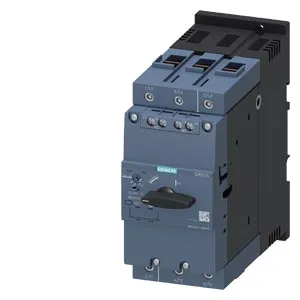
The breaker detects phase failure but does not include ground-fault detection — so if the application requires GF protection, that must be added externally via a residual-current device or ground-fault relay. At 240 VAC the breaker is rated for 100 kA, and at 690 VAC it drops to 3 kA. The 480 VAC rating is 75 A continuous, and the 600 VAC rating is also 75 A.
The depth is 176 mm, width 70 mm, height 165 mm — verify these against your enclosure depth, especially if a door-mounted operator or auxiliary contact block is planned. Main circuit terminals are screw-type. Accepts solid or stranded copper: 2× (2.5 to 16 mm²) per clamp, or a single conductor up to 70 mm². The auxiliary contact terminals accept 2× (2.5 to 16 mm²) solid. Strip lengths and torque values per the datasheet — the screw terminals are robust for panel wiring but require a screwdriver, not a push-in tool.
Switching frequency and thermal limits
Maximum switching rate under AC-3 (motor) duty is 15 operations per hour, and the same limit applies under AC-3e. That is a deliberate thermal constraint on the bimetal element — exceeding it will cause nuisance tripping or accelerated aging of the overload mechanism. For applications requiring frequent starts (e.g., reversing or jogging), a contactor with a higher rated operational current and a separate overload relay would be a better fit. Per standard practice, derate the setting by 0.5% per °C above 40 °C ambient at the breaker location.
If the buyer needs a cross-reference for a panel originally specified with a different SIRIUS frame size (e.g., 3RV2021 series), the mounting footprint and terminal layout differ — a direct drop-in without rewiring is not guaranteed. The 3RV2021-4NA25 and 3RV2021-4CA25 are smaller-frame siblings with lower breaking capacities and different terminal spacing; verify the panel cutout and busbar arrangement before substituting.