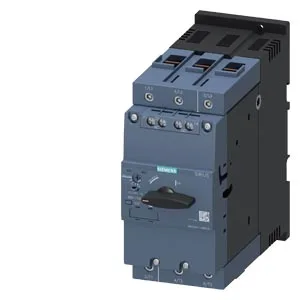
It combines a circuit breaker and overload relay in one device — a common space-saver in motor control centers.
At 400 V this breaker interrupts 30 kA. At 240 V the rating jumps to 100 kA, so on lower-voltage North American 240 V delta systems it handles virtually any utility transformer fault. The 690 V rating drops to 3 kA, which still covers most 690 V industrial loads but needs coordination checking if the transformer is large.
Depth of 176 mm — account for that behind the gland plate; it is deeper than a contactor alone because the bimetal overload mechanism sits behind the breaker body. Those are the minimums for arc quenching and heat dissipation; crowding it tighter derates the interrupting capacity.
Ratings across the voltage range
Rated operational voltage is 20 to 690 V. Horsepower ratings climb with voltage: 7.5 hp at 110/120 V, 25 hp at 200/208 V, 30 hp at 220/230 V, 60 hp at 460/480 V, 75 hp at 575/600 V. The 84 A continuous current at both 480 V and 600 V is the thermal rating — that is the max the bimetal can carry without tripping on overload, independent of the short-circuit breaking capacity.
Terminals and wiring
Accepts solid or stranded copper: 2x 2.5 to 16 mm² per clamp for the load side, and up to 2x 50 mm² or a single 70 mm² on the line side. That range covers most motor feeds up to about 75 hp at 480 V. Torque to the manufacturer's spec — overtightening strips the threads on the steel screw.
Temperature and environment
Operates from -20 to +60 °C. The 60 °C upper operating limit is higher than many panel-mounted breakers — useful if the breaker sits near a drive or transformer inside a non-ventilated enclosure.