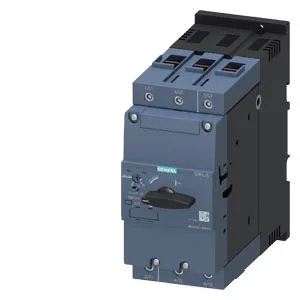
What this SIRIUS breaker does for a motor circuit
The Siemens 3RV2042-4FB10 is a SIRIUS motor-protective circuit breaker designed to sit ahead of a contactor in a motor feeder. Its CLASS 20 trip curve means it allows a motor to draw starting current for up to 20 seconds at its locked-rotor current — enough for most pump, fan, and compressor starts without nuisance tripping, but tight enough to catch a stalled rotor before the motor windings cook. That's a high-fault-rated device — it can interrupt a bolted short-circuit on a 400 V bus without the upstream breaker needing to clear it. At 690 V AC it still holds 12 kA, enough for most 690 V motor circuits in mining or marine installations.
Mounting and wiring — panel fit
Any mounting position — horizontal, vertical, flat — so you can tuck it into tight enclosure corners. The 70 mm width and 165 mm height are standard SIRIUS frame sizes; the 176 mm depth leaves enough room for wiring behind a 200 mm deep enclosure. Accepts 2x (2.5... 16 mm²) solid or stranded on the line/load side, and up to 2x (2.5... 50 mm²) or 1x (10... 70 mm²) for larger conductors. That covers most motor feeder cables up to about 50 mm².
The horsepower ratings tell you what motor it can protect: 7.5 hp at 230 V, 15 hp at 200/208 V and 220/230 V, 30 hp at 460/480 V, and 40 hp at 575/600 V. At 400 V, the breaking capacity is 50 kA — not the 100 kA you get at 400 V AC, so check which rating applies to your system voltage. The switching frequency is 15 operations per hour at AC-3 and AC-3e maximum — that's about one start every four minutes, which suits process motors but not rapid-cycling applications like stamping presses.